
A VISION FOR THE FUTURE WITH AN EYE ON THE PAST
 August
1997
August
1997
 "Makani
luna ke lele 'ino mai la ke ao."
"Makani
luna ke lele 'ino mai la ke ao."
There is a wind from the upland for the clouds are set a flying.
Chief Keoua kuahu'ula's priest's observation of the clouds and wind, just
before landing their canoes at Kawaihae for a meeting with Kamehameha,
proved ominous as Keoua kuahu'ula was bludgeoned to death soon after stepping
ashore. This event marked the beginning of Kamehameha's quest to conquer
and unify the Hawaiian Islands. Today, Pu'ukohola Heiau continues to overlook
Kawaihae and remains as a poignant reminder of its importance in Hawaiian
history. 
Kawaihae remained virtually unchanged for almost two hundred years. An
aerial photograph taken in 1949 shows a meandering coastline with beaches
and small fishing boats anchored near shore, protected by the large, fringing
reef half a mile or more off shore. In the mid 1950's, construction was
started on Kawaihae deep draft harbor by the U.S. Army Corps of Engineers
and was completed in 1959. The construction of the harbor forever changed
the face of Kawaihae.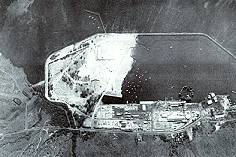 In 1969, Operation Tugboat, conducted by the US Army Engineer Nuclear
Cratering Group, using conventional explosives, blasted out the existing
basin located at the southern end of the harbor for light draft vessels.
Today, breakwater construction is underway to finish the much needed small
boat harbor.
In 1969, Operation Tugboat, conducted by the US Army Engineer Nuclear
Cratering Group, using conventional explosives, blasted out the existing
basin located at the southern end of the harbor for light draft vessels.
Today, breakwater construction is underway to finish the much needed small
boat harbor.
Surfing
has always been a part of Kawaihae's history with its ideal formation.
The large expanse of edging reef which fronts the breakwater including
the Spencer Park area contains a number of surf spots.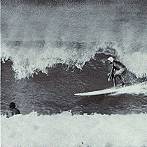 These breaks are located over a well developed bench reef which extends
several hundred yards out to sea from the edge of the breakwater. This
configuration creates a long, slower peeling type of wave ideal for longboards.
Waves surfed at Kawaihae are generated from immense, low pressure systems
in the northwest Pacific, usually during the winter and early spring months.
These breaks are located over a well developed bench reef which extends
several hundred yards out to sea from the edge of the breakwater. This
configuration creates a long, slower peeling type of wave ideal for longboards.
Waves surfed at Kawaihae are generated from immense, low pressure systems
in the northwest Pacific, usually during the winter and early spring months.
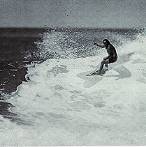 Kawaihae
was a royal center where Ka'ahumanu, Kamehameha's favorite wife and an
accomplished surfer was known to have ridden the waves while in residence
there with the king. Since those days, little or no surfing took place
at Kawaihae until the early 1970's. A few local surfers and part time
Big Island surfers, such as Whitey Harrison, rode the breakwater, but
it was not until the early 1980's, with the rebirth of longboards, that
Kawaihae became the popular surfing mecca that it is today.
Kawaihae
was a royal center where Ka'ahumanu, Kamehameha's favorite wife and an
accomplished surfer was known to have ridden the waves while in residence
there with the king. Since those days, little or no surfing took place
at Kawaihae until the early 1970's. A few local surfers and part time
Big Island surfers, such as Whitey Harrison, rode the breakwater, but
it was not until the early 1980's, with the rebirth of longboards, that
Kawaihae became the popular surfing mecca that it is today.
When Kawaihae
harbor was constructed, a significant area was filled with coral dredged
from the deep draft harbor basin. This section, for the most part, remains
undeveloped, with the exception of the Army LST Ramp and staging compound.
Just makai of that is a flat, coral-filled area which borders on the ocean.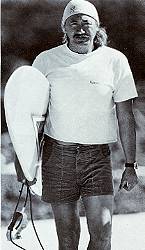 This zone, in recent times, has been the gathering place for surfers riding
the Kawaihae breakwater.
This zone, in recent times, has been the gathering place for surfers riding
the Kawaihae breakwater.
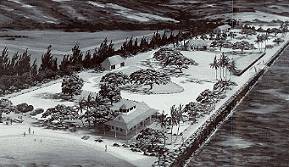
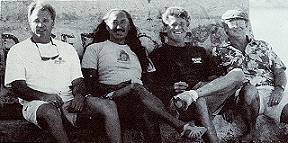
In 1992, Tiger Espere, a well-known surfer and water man created the "Tiger Espere Longboard Classic" surfing contest. For the last five years, it has brought together surfers from this island and other areas in the state to compete in an atmosphere of friendship and fun. Additionally, it has given many of us the awareness of the importance of this area, both as a recreational reserve and an historical/cultural resource. Through Tiger Espere's efforts and leadership, the dream to create a cultural surf park at the breakwater site has become a reality. Senate Resolution No. 10, a "Senate Concurrent Resolution Urging That The Pua Ka ilima'O Kawaihae Be Designated A Site For Recreational, Educational And Cultural Activities" was passed in this year's legislative session. "Pua kA ilima" is the name of a small island which was once located at Kawaihae. The island was named for the ilima flower which flourished upon it. Thus, the nonprofit corporation known as the Pua Ka'ilima Cultural Surf Park Inc. has been formed to develop and protect the area. Funded, not by taxpayers' money, but rather with community and foundation support, the park will be developed in phases over the next several years. The first stage will concentrate on landscaping, including wind breaks and grassed areas, restrooms and showers. Additional phases will include Hawaiian cultural event facilities and a surf lifesaving clubhouse.
 Pua Ka'ilima needs the support of the community to succeed. If you would
like more information on the surf park, or to make a contribution towards
its development, please contact Dave Barclay at 889-5225 or Bob Simms
at 885-3534. Donations are tax deductible.
Pua Ka'ilima needs the support of the community to succeed. If you would
like more information on the surf park, or to make a contribution towards
its development, please contact Dave Barclay at 889-5225 or Bob Simms
at 885-3534. Donations are tax deductible.